Hamilton & Scourge
On the night of August 7, 1813, two American warships — the Hamilton and the Scourge — capsized in a sudden squall off Burlington and went down with at least 53 men. They were merchant schooners the U.S. Navy had bought and armed, and they sit on the lakebed still, preserved in cold fresh water. The plaque looks out at the water they never came back from.

CC BY 2.0 · Jeff Hitchcock · source
.jpg)
See the place
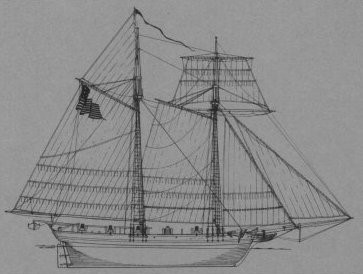
Public domain · U.S. Navy (via Wikimedia Commons) · source


Public domain · U.S. Navy (via Wikimedia Commons) · source

Find the plaque
The story
The Squall
The night of August 7–8, 1813. An American squadron was cruising Lake Ontario when a sudden, violent squall tore through the fleet — lightning, black water, sails still set. The Hamilton Civic Museums, which steward the site's memory, describe what happened next: in the early morning hours of August 8, the Hamilton and the Scourge "foundered during a storm on Lake Ontario off Port Dalhousie," capsizing "in a matter of moments." The death toll was at least 53 crewmen — "the largest loss of United States naval personnel in a single event during the War of 1812." Canadian Geographic puts it more plainly: 53 sailors taken "to their watery graves" in the lake's "cold, dark waters." They were merchant hulls pressed into naval service, carrying more gun than they'd been built for — in the dark, with no time to shorten sail. Not a battle, not an enemy broadside: weather. The largest single loss the U.S. Navy suffered in the entire war, and it wasn't inflicted by anyone.
Two Merchantmen in Uniform
Neither ship was born a warship. The Hamilton began life as the Diana, an American merchant schooner; the Scourge as the Lord Nelson, a Canadian merchant topsail schooner. They were, in the Civic Museums' words, "simple merchant ships that were pressed into service for the American Navy" — the Scourge illegally seized by the Americans before the war even started. As warships they were improvisations, and it showed. The Hamilton carried eight 12-pounder carronades plus a big pivot-mounted "Long Tom" — a 24- or 32-pounder amidships — with a crew of fifty. The Scourge mounted eight smaller guns, four 6-pounders and four 4-pounders, also with fifty men. Both did real service: each played a role in the American capture of Fort George in May 1813. They were workhorses — warships the way a minivan with a roof rack is an expedition vehicle. Sturdy enough until the weather asked more of them than they'd been built for.
The Men Who Didn't Come Home
The men who died that night are mostly nameless now — but one of them talked. Ned Myers, a sailor on the Scourge, survived the sinking and years later told the whole story to James Fenimore Cooper — yes, the Last of the Mohicans novelist — who published it as a biography, A Life Before the Mast. The Civic Museums preserve Myers' own words about the last minutes: "The flashes of lightning were incessant, and nearly blinded me. Our decks seemed on fire, and yet I could see nothing. I heard no hail, no order, no call; but the schooner was filled with the shrieks and cries of the men..." Fifty-three sailors went down with the two ships. Every August, Hamilton holds a sunset ceremony at the Naval Memorial Garden in Confederation Park — right near this plaque — to mark the loss. Members of the American Legion in Canada tend the markers, placing a new star-spangled banner on each one. Two centuries on, the flags still go up every year.
90 Metres Down, Perfectly Kept
The wrecks waited 160 years. In 1973 Daniel Nelson — a dentist from St. Catharines — found both hulls; they lie upright, sources wobbling between 88 and 90 metres down, roughly 500 metres apart. And they are astonishing: masts still standing, cannons visible on deck, the cold dark water holding everything in place. The lake is a time capsule — little light, little oxygen, barely above freezing. The finds drew the greats: Jacques Cousteau filmed them in 1980, National Geographic's Emory Kristof in 1982, Titanic-finder Robert Ballard in 1990. In 1976 the site was designated a National Historic Site of Canada, as rare surviving examples of merchant ships converted to warships. Today the City of Hamilton owns and manages them. You can't dive them, and you can't see them from the plaque — but stand at Confederation Park, look out over the water, and you're looking at the roof of a perfectly preserved 1813 world.
And the dentist didn't just get lucky: as a Royal Ontario Museum research associate in 1971, Dan Nelson tracked down the “lost” log of the British flagship HMS Wolfe in American archives, and turned its August 8, 1813 entries into a “most probable area” map — after 1960s searches had found nothing.
The local guide
☕ Cafes
Pistachio mocha, then a bag of Evergreen roast to take home.
A Hamilton beach institution since 1946 — family-owned, right on the sand. Fish and chips, or the Sportsman burger if you're properly hungry.
Waffle sandwich — bacon and cheddar on their house-made waffle.
🍽️ Restaurants
Greek on a big lakefront patio. Slow-braised lamb shank, chicken souvlaki, and you can watch the lake while you wait.
The Beach Beef sandwich. It's what the beach-strip regulars get.
Oyster taco. The whole kitchen is 100% gluten-free, which is rarer than it sounds.
🛍️ Shopping
An 1840s ivory-and-gold toothpick — yes, really. An oddities shop that feels like a museum.
Four floors and 200+ booths of antiques and vintage on Ottawa Street, ten minutes' drive. Go in with an hour — you'll need it.
Hand-painted oriental-inspired cabinet. Consignment turns over fast, so it pays to browse.